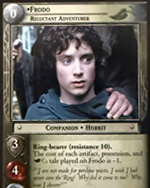
 Publisher: Decipher
Summary
The Lord of the Rings Trading Card Game was a card game by Decipher, based around the trilogy of films. In the game, you form a fellowship and quest through locations to destroy the One Ring, despite opposition from the forces of Sauron.
The game is slightly unusual in that it has a separate set of starter deck rules than standard game rules, and the starter decks were built to utilize these rules. It was distributed in starter decks, 11-card booster packs, draft packs, draft boxes, and tournament and promotional cards.
The LotR TCG continues to be supported by the Player's Council, which sporadically releases new "virtual" sets of cards (with the last set being released in December 2025). We're not counting virtual sets, so for purposes of this writeup, the game is defunct.
Card Types
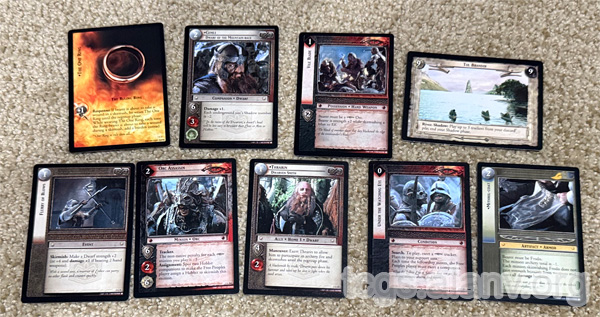
- The One Ring - A card representing the ring of Sauron. Each deck must have one to start the game, and each has an ability that (in some way) can allow the ringbearer to take burdens instead of wounds.
- Site - A card representing a location that you journey through, stored in a separate deck from your main deck. Each has a shadow number, effects, an arrow, and may have a site number (removed after the Mount Doom set).
- Companion - A card representing a main character in the fellowship. Each has a twilight cost, culture, strength, vitality, and may have effects or abilities. They may have a signet and companions that can bear the ring have a resistance (to burdens).
- Minion - A card representing an opposing Shadow creature or character. Each has a twilight cost, culture, viality, a site number, and may have effects or abilities.
- Ally - A card representing a friendly character helping the fellowship. Each has a twilight cost, culture, strength, vitality, and may have effects. They may have a signet. These only exist through the Mount Doom set.
- Follower - A card that works like an ally. Each has a twilight cost, culture, and effects, and "attach" to companion cards. These were introduced in the Bloodlines set, somewhat replacing Ally cards. Belongs to either the Free Peoples or Shadow faction.
- Possession - A card representing an item used by the fellowship or Shadow creatures. Each has a twilight cost, culture, strength bonus, and effect. Belongs to either the Free Peoples or Shadow faction.
- Artifact - A card representing a particularly rare or special item. Each has a twilight cost, culture, and effect. Belongs to either the Free Peoples or Shadow faction.
- Event - A card representing an unexpected occurrence. Each has a twilight cost, culture, and effect. Belongs to either the Free Peoples or Shadow faction.
- Condition - A card representing a persistent event. Each has a twilight cost, culture, and effect. Belongs to either the Free Peoples or Shadow faction.
Sets and Decks
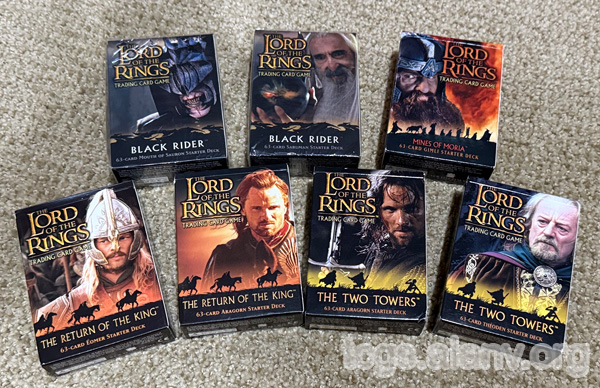
The game saw a total of 15 booster sets released: Fellowship of the Ring, Mines of Moria, Realms of the Elf-Lords, The Two Towers, Battle of Helm's Deep, Ents of Fangorn, The Return of the King, Seige of Gondor, Mount Doom, Shadows, Black Rider, Bloodlines, The Hunters, Rise of Saruman, and Treachery & Deceit. There was also a special Reflections set, a Expanded Middle Earth set for the deluxe draft boxes, and two special self-contained sets: The Wraith Collection and Age's End.
All booster sets except the last (Treachery & Deceit) had starter decks; most had two different decks per set, although Shadows had four. Starter decks include slightly different rules from other more standard formats. Fellowship of the Ring and The Two Towers also had "deluxe" starter sets, which included booster packs and a full rulebook.
The game also had Draft Packs, featuring semi-randomized blocks of cards that could be used as the basis for a draft tournament deck, as well as draft boxes featuring some exclusive cards and booster packs.
All booster sets included common, uncommon, and rare cards, and the Reflections set also had R+ cards. There were also starter-only rarities (often marked as P for Premium instead) as well as tournament and promotional cards. Later sets included "Legends" rarity cards as well.
Deck Composition and Contents
Starter Decks
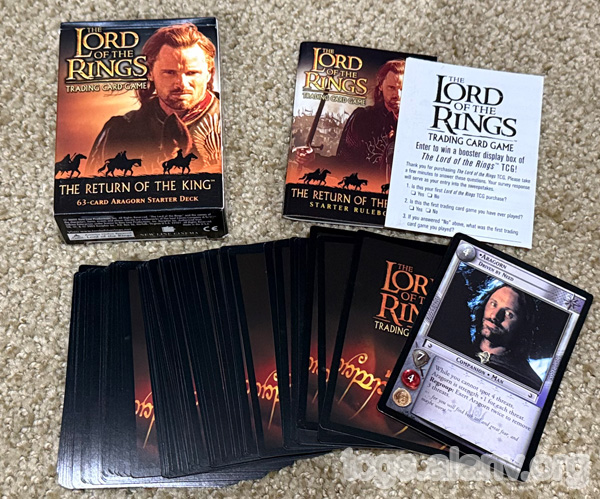
Decks: Box Indicates Contents
Players: One
Size: Full Starter-Legal** Deck
Rarities: Common, Uncommon, Rare, Starter
Rulebook: Included
Playmat: Not Included
Other Items: Survey Sheet
The first 14 booster sets included starter decks: Aragorn and Gandalf for Fellowship of the Ring, Gandalf and Gimli for Mines of Moria, Boromir and Legolas for Realms of the Elf-Lords, Aragorn and Theoden for The Two Towers, Eowyn and Legolas for Battle of Helm's Deep, Faramir and The Witch-King for Ents of Fangorn, Aragorn and Eomer for Return of the King, Merry and Pippin for Seige of Gondor, Frodo and Sam for Mount Doom, Aragorm and Eowyn and Gandalf and Legolas for Shadows, The Mouth of Sauron and Saruman for Black Rider, Arwen and Boromir for Bloodlines, Aragorn and Mauhur for Hunters, and Uruk Rampage and Evil Man for Rise of Saurman.
*Two sets (Battle of Helm's Deep and Ents of Fangorn) included three fixed rares along with the 60-card deck. Every other set included three random rares.
**The game is slightly unusual in that the starter decks use slightly modified rules from the full standard game. For example, only 7 sites (instead of 9) are used, draw decks are smaller than 60 cards, and the card balance in the deck does not have to be even between factions. All starter decks are fully legal for starter rules, but are (naturally) not legal with the full rules.
Starter deck contents (other than the three random rares in most sets) were fixed, and the boxes indicated which deck you would get. Each deck includes one starter-only rarity card, with the remaining fixed cards being common and uncommon rarity.
Deck Rarity Analysis
I'm primarily a collector, and there's a reason why Decipher is my all-time favorite card game company. In addition to their games generally being good (especially in their "golden age" of Star Trek 2E and .hack and Megaman), they're also extremely collector-friendly.
Randomized rares (with the exception of two sets, after which they reversed course), starter-only rarity cards, and decks including only common and uncommon cards? Plus everything comes in a very compact box along with a rulebook? Yes, please.
I do find the decision to have separate "starter rules" rather interesting. On the one hand, I appreciate that it simplifies the game for new players. On the other... the decks are only 11 cards short of being fully legal sized (plus they already include 9 sites, and the rules just tell you to not use 8 and 9), so it would've been nice for them to at least include enough cards (even if other deck rules like faction balance are violated).
It's also really funny contrasting the physical size of this game's starter decks with something like World of Warcraft. You can fit a box of 12 starter decks into the same physical space as two World of Warcraft starter decks. It makes Decipher games take up far less space on my shelves, which I greatly appreciate.
Alan's Thoughts On The Game
Will be updated once I've played the game.
Resources
- Player's Council (includes rules and info, and facilitates online play)
- Player's Council Wiki (includes lots of info)
- LotR Wiki (includes info and card lists)