 Publisher: Wizards of the Coast
Summary
The Neopets Trading Card game was a card game by Wizards, based around the popular online game. In the game, you equip your Neopets to compete in four different stat-based arenas, and bank cards for victory points when you win those contests.
The game was distributed in starter decks, preconstructed decks, 8-card booster packs, and promotional cards.
The game had tie-in with the online browser game, as well. Many set released with plot developments that had in-game events and rewards. The TCG also included prize code cards that could be redeemed in the online game.
The game should not be confused with the newer Neopets Battledone Trading Card Game, produced by Upper Deck.
Card Types
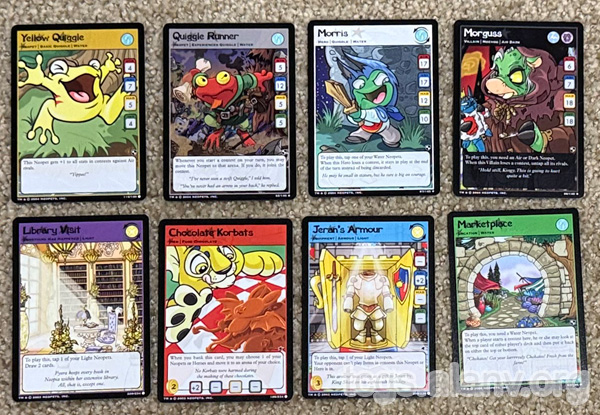
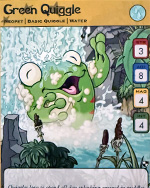
- Basic Neopet - Neopet cards that come from a separate deck and play for free. Each has stats (strength, agility, magic, and intelligence) and keywords, and may have a faerie.
- Experienced Neopet - Neopets that replace basic neopets. Each has stats, keywords, and an ability, and may have a faerie.
- Hero - Like an experienced neopet but only lasts for one turn.
- Villain - Evil neopets who 'block' arenas until they're defeated in a special contest.
- Equipment - Items that can equip onto neopets and heroes. Each has stat boosts and may have an ability. Each also has a bank value (toward victory).
- Item - Items that can be used during contests to boost stats and provide effects. Each also has a bank value (toward victory).
- Something Has Happened - Special events that change the game. Each has an effect and may have a faerie.
- Location - Places where you have contests. Each modifies an arena. Has an effect, and may have a faerie. Introduced with Battle for Meridell
- Fate - Ongoing occurrences. Curses apply to opposing neopets, while quests apply to your own. Each has an effect, and may have a faerie. Introduced with Hannah and the Ice Caves.
Sets and Decks
The game saw a total of ten sets released: Base Set, Battle for Meridell, Return of Dr. Sloth, Mystery Island, Hannah and the Ice Caves, Curse of Maraqua, Lost Desert, Darkest Faerie, Travels in Neopia, and Haunted Woods. There were also promotional cards
The base set had starter decks, and Battle for Meridell had preconstructed decks. Unusually, no other decks were released with subsequent expansion sets.
Like other Wizards games at the time, there was a holo rare rarity above rare, and all sets had this rarity.
You could also find prize codes in booster packs, which unlocked special items in the online game. (World of Warcraft, eat your heart out.)
Deck Composition and Contents
Starter Decks
Decks: All Same
Players: Two
Size: Two Legal Reduced Decks
Rarities: Common, Uncommon, Rare, Starter
Rulebook: Included
Playmat: Included
Other Items: 2 Dice, Booster Pack, Survey Sheet
The starter deck had two 30-card decks (Blue Mynci and Red Korbat) and was intended for two players to learn the game. (A full legal deck is 10 basic neopets, and 40 or more deck cards.)
Starter deck contents were fixed, and all starters contained the same cards. The cards are a mix of common, uncommon, rare, and starter-only cards: Each deck's 6 basic neopet cards are exclusive to starter decks (3 per 30-card deck), numbered like S1/S6, and marked as either holo or common rarity, but these cannot be found in booster packs (and actually aren't even in the official online checklists) making them starter-only rarity. Each deck also includes two non-holo rare cards (one per 30-card deck).
The playmat includes basic "learn to play" rules on it, and a full rulebook (called the "advanced rulebook") was also included. Boxes also included dice and a booster pack.
Preconstructed Decks
Decks: Box Indicates Contents
Players: One
Size: Full Legal Deck
Rarities: Common, Uncommon, Rare
Rulebook: Included
Playmat: Not Included
Other Items: None
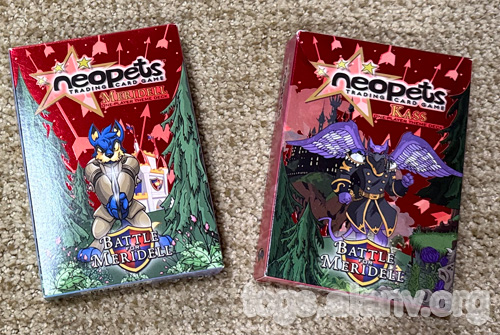
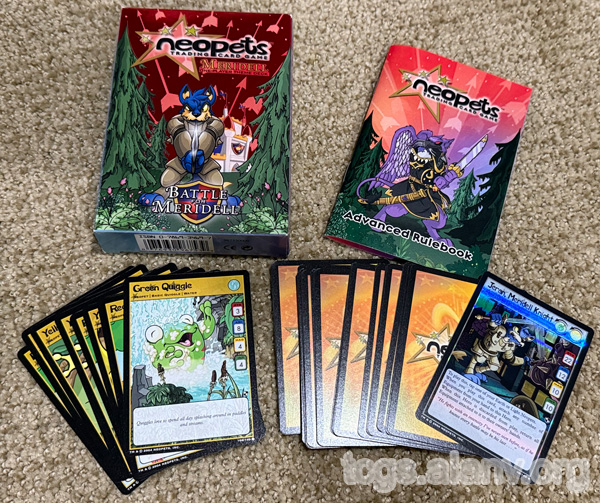
Two preconstructed decks (Meridell and Kass) were released with the Battle for Meridell set. Each comes with a full 50-card deck (10 basic neopets, and 40 deck cards).
Preconstructed deck contents were fixed, and the boxes indicated which deck you would get. The decks themselves are a mix of common, uncommon, and rare cards. Each deck includes two rare cards, one of which is foiled (when it would normally be non-foil if found in a booster pack). The foil card is the deck's "theme" card (Jeran for Meridell, Draik Skeleton for Kass).
These include a full (advanced) rulebook, but do not include dice, playmat, or booster pack.
Deck Rarity Analysis
Fine. Each deck including a rare is standard, although I think Wizards did a good job with the holo cards, making them exclusive in some way (starter-only rarity for the base set, holo versions of non-holo rares for Meridell).
The inclusion of a booster pack in the basic starter set is also great. I wish more games would do something like this, since it gives incentive to people like me (who buy boxes of starter decks on clearance) to actually open the products.
Alan's Thoughts On The Game
I first played this game nearly 20 years ago, and revisited it recently as part of putting together this writeup. It's fine.
Basic neopets being a separate deck is a great touch, since you really need them to do anything, and it removes the possibility of deck screw around drawing them. The rules are relatively simple, but there's a decent amount of strategy, and the game also feels very thematic and true to the source material. (This makes sense given how involved the creators of the online game seem to have been with the TCG.)
The biggest problem with this game is the fact that item and equipment cards are both the only real ways to increase stats in contests and are the only cards that can be banked for points. Combine this with the fact that you'll really only have three neopets in play (and therefore really only defend three arenas at once, save for one-turn-use heroes you can sporadically summon) and it never made sense during our games to use the item cards for their stat boosts. Instead, it was better to keep them in our hands as bank material (and the games always came down to who drew bankable cards at the right times).
I actually do like the dice mechanic in this game, because it gives your neopets a fighting chance at defending (or winning) a close contest, and rolling a 6 is a surprisingly interesting lucky roll (for example, my opponent defeated my hero in what was otherwise a very one-sided battle).
So, yeah. The game is fine. I think it would be improved if every card in the game was bankable for points toward victory, because it would make items more likely to be played (and therefore make contests more interesting). But it's playable.
Resources
- Player Committee
- Jellyneo (includes rules, info, and a full card listing)
- Starter Deck Card Lists (AlanvDotOrg Randomjunk)