 Publisher: Bandai
Summary
The Power Rangers Action Card Game was a card game by Bandai, based on the Power Rangers series of shows. In the game, you play ranger and villain cards to face off one-on-one in an arena.
The game ties in to mobile app and a Deluxe Gosei Morpher toy. The cards can be scanned by the mobile app to unlock videos, or can be used in the morpher to play sound effects. Both the app and toy can also be used for the random selection mechanic in the card game.
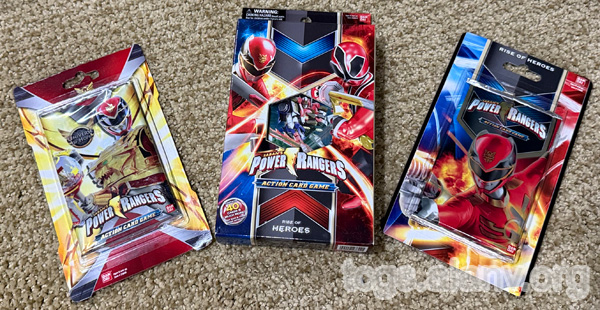
The game was distributed in starter decks and 10-card booster packs, as well as promotional cards.
Card Types
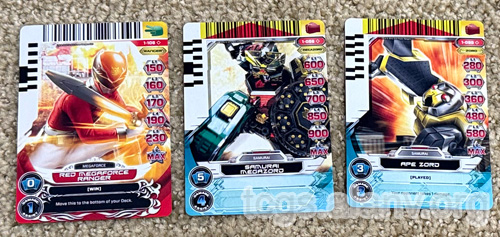
Every card in the game has the same elements: A rock-paper-scissors symbol, power levels and values, a cost, a damage value, and an assist value. Each may also have an effect and effect timing. They also contain barcodes for the mobile app and the morpher toy.
- Ranger - Cards representing various Power Rangers.
- Villain - Cards representing various villains in the series.
- Zord - Cards representing the basic ranger-specific vehicles.
- Megazord - Cards representing larger joined vehicles.
- Support - Cards representing characters that can help out.
Sets and Decks
The game saw a total of four sets released in the US: Rise of Heroes, Guardians of Justice, Universe of Hope, and Legends Unite. A fifth "compilation" set, Keepers of Peace, was released only in Europe but did not see a US release, combining cards from the other sets with some new cards. There were also promotional cards.
The Rise of Heroes and Universe of Hope sets had two-player starter decks.
Starter deck cards are only found in starter decks (effectively making all such cards starter-only rarity, despite having marked rarities). The game had super rare and ultra rare cards, but does not have uncommon cards, and multiple rare cards were found in a booster pack. This effectively makes the "super rare" cards regular rares (by other card game standards), as one was found in each pack.
Deck Composition and Contents
Starter Decks
Decks: Box Indicates Contents
Players: Two
Size: Two Reduced Legal Decks or Full Legal Deck
Rarities: Starter
Rulebook: Included
Playmat: Included
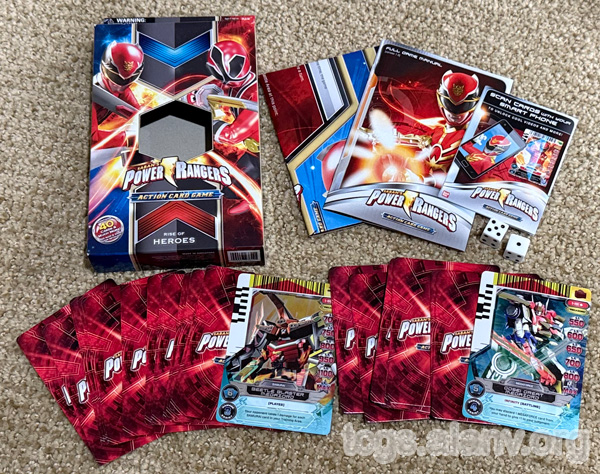
Other Items: 2 Dice, App and Toy Promo Sheet
Two starter decks were available, one for Rise of Heroes and one for Universe of Hope. Each starter deck contains two 20-card decks (Megaforce and Samurai, for both sets). A full deck is 30 cards, so a single starter can be used to make a full legal deck for one player.
Starter deck contents were fixed, and the boxes indicated which deck you would get. The cards in each deck are only found in the starter decks, making them starter-only rarity, despite each card having a marked rarity. Two of the cards (one per deck) are foiled.
The box also includes a rulebook, 2 dice, and a playmat. The playmat includes basic rules for the "entry game".
Deck Rarity Analysis
Perfect. Starter-only rarity and all decks are the same.
Worth noting: Unlike many other Bandai games, the numbering in this game actually makes some sense, with the card number indicating the set and having a consistent numbering within the set. Of course, they screwed up rarity for collectors (with cards being marked as "rare" acting more like regular uncommon cards, in other games, since you get three plus a "super rare" or ultra rare card in each booster pack), so they apparently can't get everything right at once.
Alan's Thoughts On The Game
Yeah. The game is fine.
This game falls into a bucket I'm calling "Games that are extremely simple but don't try to be anything they're not", which includes games like Marvel ReCharge. This game clearly exists to sell itself (and the associated Gosei Morpher toys) to kids. The gameplay is secondary.
And sure, the gameplay involves a rather large amount of randomness (for example, I had a single cost 0 power ranger beat a megazord because it rolled 6 twice in a row and my opponent could no longer assist their judgement, and I lost one game because I lost to a megazord and also happened to lose rock-paper-scissors, which doubled the damage to 8 cards). But when a game is over in less than 5 minutes, that randomness isn't a huge deal, because you're not particularly invested in the outcome of a single game.
But I was actually also surprised by how much strategic depth exists around that randomness. The Training Area is a great mechanic to allow players to recover from losses, and where and when you use those cards to bump your judgement (or use them to summon a megazord!) has a lot of strategy to it. Likewise, when you summon a zord is an interesting question. (In our games, the abilities weren't all that interesting decision-wise, but I imagine this changes if you build a custom deck.)
So, yeah. It's a fine game. I'd pull it out as a very quick and casual thing between other games if we wanted something mindless. Good job Bandai? (I'm as shocked as you are that I'm saying those words.)
Resources
- Unofficial Fan Site (includes info and a full card listing)
- Starter Deck Card List (AlanvDotOrg Randomjunk)